

















































For the better part of two years, the UAE’s Federal Climate Law existed mostly as a future milestone, something on the calendar with a deadline far enough away to feel abstract. That deadline has now passed. As of the end of May 2026, greenhouse gas reporting stopped being a voluntary sustainability gesture and became a legal obligation, one that reaches every business generating emissions in the country, with no exemption carved out for size or sector.
Construction has more reason than most industries to take this seriously, and more to gain from doing so well. It remains one of the most emissions-heavy sectors in the country, and cement production alone carries a heavy carbon footprint before machinery, energy use, and cross-border supply chains are even factored in. That makes construction the clearest test case for what this law is actually trying to achieve, and the sector best positioned to show what real progress looks like.
None of this works without the right foundations in place first. Reporting accurately on emissions means having the systems to track them in the first place, and for many construction firms, that infrastructure simply does not exist yet. Fuel use on site, energy drawn from grid connections, emissions embedded in materials before they even arrive at a project, all of it needs to be captured, verified, and reported in a form that stands up to scrutiny.
Building that capability is not a one-off task. It requires ongoing investment in data systems, in training the people responsible for collecting the numbers, and in supply chain relationships that can actually produce reliable figures rather than estimates. Companies that treat this as a documentation exercise rather than an operational one will find themselves reporting numbers they cannot fully stand behind, which defeats the purpose of the law before it has even had a chance to take hold.
The real opportunity is not in the companies rushing to clear the deadline. It is in the ones treating it as the start of something rather than the end of it. A version of compliance has taken hold in some corners that is little more than paperwork: register, file the r eport, and change nothing about how the building actually gets built. This law is asking for more than that, and rightly so. It is asking for proof of genuine reduction, not a more polished way of measuring the same behaviour, and it backs that ask with real weight, with fines reaching up to AED2 million ($540,000) for non-compliance and doubling for repeat offences.
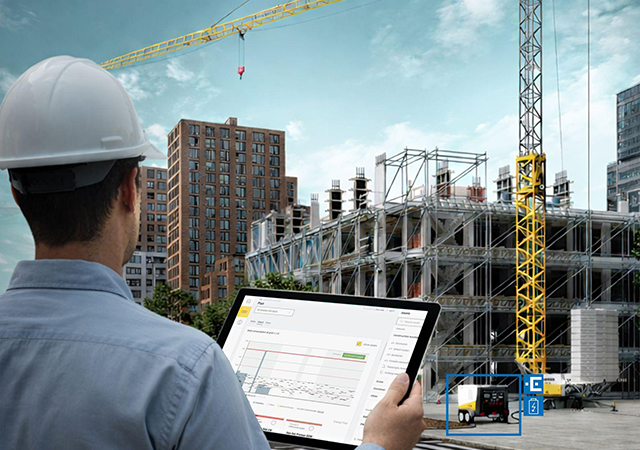
Reporting accurately on emissions means having the systems to track them.
That distinction is the real story here. The gap that matters sits between businesses that treat this law as a box to check and businesses that treat it as a reason to look again at how projects get specified, sourced, and built. The tools to do that are not experimental. Proven lower-carbon building solutions, including circular cements and low-emission concrete systems, waste reduction in how sites are run, and more deliberate sourcing decisions, are available today. What has been missing is the will to treat them as strategy rather than as an afterthought.
There is a cost question underneath all of this that deserves honest treatment rather than avoidance. Lower-carbon materials, cleaner logistics, and more efficient site practices tend to carry a higher price upfront, and that reality has made some companies hesitant to move faster than the law strictly requires. But the framing of that cost as pure expense misses what is actually happening in the market. Contracts are increasingly weighted toward firms that can demonstrate credible progress, and financing terms are beginning to reflect environmental performance in ways they did not two years ago. Viewed over a project’s full lifecycle rather than at the point of purchase, the calculation looks different. The companies waiting for costs to fall before acting are also the ones most likely to be paying a premium for compliance later, once the requirements tighten and the window for gradual adjustment has closed.
A larger shift is also coming, one most companies have yet to plan for. Today’s law looks inward, at the emissions a company produces directly. Attention is expected to widen toward emissions across entire supply chains within the next year or so which, for construction, means tracing everything from where materials are sourced to how they travel to construction sites. Companies embedding sustainability and circularity in their business and implementing real measurement, reporting, and accountability will already be ahead of that curve. Companies that treat the current deadline as the finish line will have further to catch up later on.
This is no longer only a regulatory story either. It has become a competitive one. Developers, financiers, and government tenders are beginning to ask sharper questions about a contractor’s environmental footprint before any deal is signed. A clean compliance record is quietly becoming currency, not just a formality to file away.
The UAE’s position within the region adds another layer worth noting. Federal climate legislation of this scope remains rare across the Gulf, which means companies operating here are being asked to build reporting muscle well ahead of many regional competitors. That can read as a burden in the short term, but it is also a head start. Firms that get comfortable with rigorous emissions accounting now will be better placed as neighbouring markets introduce their own requirements, rather than scrambling to build the same capability from scratch under tighter deadlines. In a region where construction pipelines cross borders and supply chains rarely stay within a single jurisdiction, that early fluency can be a major advantage in the long run.
The path forward is straightforward. Companies treating this law as a ceiling will spend the next few years managing risk from underneath it. Those treating it as a floor, building upward from there, will be the ones shaping what gets built in this country for the decade to come.
The law has arrived, and with it a clear signal about where the industry is headed. The easier work, registering, filing the first report, is largely behind the industry now. What comes next, whether construction actually changes the way it builds, is the part that will show whether this moment becomes a genuine turning point.