























The total value of projects planned or underway across Saudi Arabia reached $2.07 trillion in H1 2026, highlighting the scale of the Kingdom’s long-term development ambitions under Vision 2030, according to Knight Frank’s latest Saudi Arabia Construction Landscape Review.
Of the $2.07 trillion total project pipeline, $1.23 trillion comprises construction and real estate projects, while the remaining $940 billion is across power, transport, industrial, water, chemical, gas and oil projects.
Construction remains a major component of the Kingdom’s development activity, with construction-sector output forecast to reach approximately $190.4 billion in 2026, compared with $179.4 billion in 2025, before rising to around $250.2 billion by 2030.
However, the ongoing regional conflict is creating additional pressure across the construction and development sector. Disruption to regional shipping and supply chains, alongside higher logistics and input costs, is creating risks around procurement, project timelines and delivery costs, particularly for projects reliant on imported materials and equipment.
Faisal Durrani, Partner – Head of Research, MENA at Knight Frank, said: “The scale of Saudi Arabia’s project pipeline demonstrates the strength of the Kingdom’s long-term ambitions under Vision 2030. At $2.07 trillion, the pipeline reflects the breadth of development planned across the Kingdom, although it is important to recognise that projects are at different stages of planning and delivery.
“At the same time, the ongoing regional conflict has created a materially more challenging delivery environment. Rising construction and logistics costs, potential supply-chain disruption and longer procurement and construction timelines are increasing pressure on project economics. Against this unprecedented backdrop, some projects may need to be rephased, revisited or reassessed to ensure that they remain commercially viable and aligned with changing delivery conditions.”
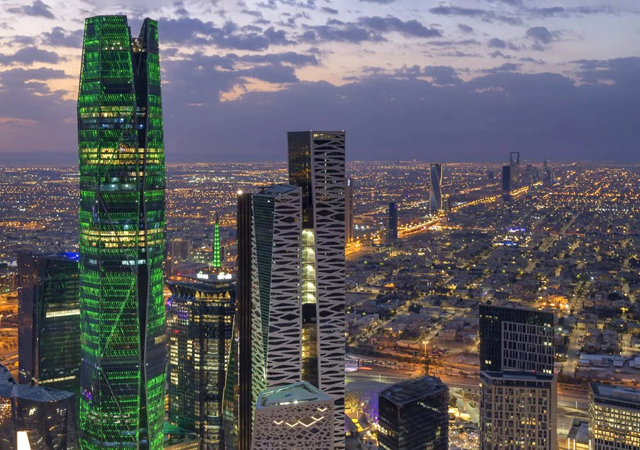
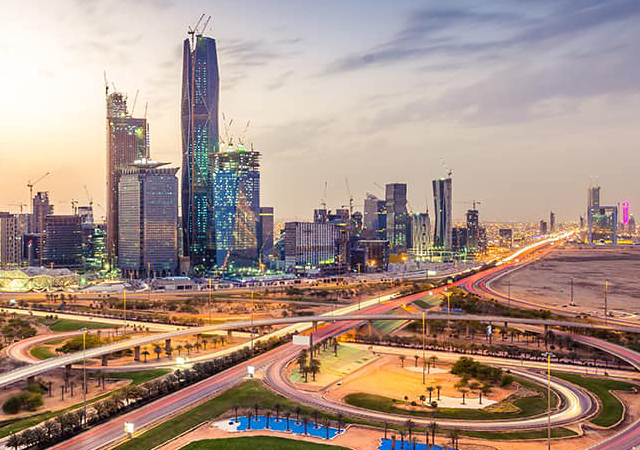
Riyadh remains at the centre of construction activity
Approximately $293.1 billion worth of construction, industrial and transport contracts were awarded across Saudi Arabia between 2020 and August 2026.
Riyadh province accounted for $135.4 billion, or approximately 46% of the total, including $96.1 billion of construction contracts and $34.8 billion of transport contracts. Makkah Province followed with $48.1 billion, while the Eastern Province accounted for $39.9 billion.
Mohamed Nabil, Regional Partner – Head of Project and Development Services, MENA at Knight Frank, said: “The scale of Saudi Arabia’s construction pipeline remains significant, but the operating environment for developers and contractors has become considerably more demanding. The impact of the regional conflict is increasingly being felt at project level through construction material costs, procurement and delivery programmes."
Between January and July 2026, reinforcing steel bar prices rose by approximately 24%, iron-binding wire by 19.6% and aluminium by 13.9%. These increases are adding pressure to project budgets at a time when supply-chain disruption and longer lead times are also complicating procurement.
“For developers and contractors, the implications extend beyond higher costs, with some projects potentially requiring changes to scope, phasing or procurement strategy to remain deliverable and commercially viable.”
Residential construction costs move higher
Knight Frank’s analysis shows that residential construction costs have increased across all segments over the last year.
Standard villa construction costs have risen from SAR3,800–4,400 per sqm in 2025 to SAR4,100–4,800 per sqm in 2026, while high-end villa costs now range between SAR6,000 and SAR8,700 per sqm, compared with SAR5,500–8,000 per sqm last year.
For apartments, standard construction costs have risen from SAR4,700–5,800 per sqm to SAR5,100–6,300 per sqm, while high-rise apartment construction costs have increased to as much as SAR10,800 per sqm, from SAR10,000 per sqm in 2025.
While construction cost pressures pre-date the latest escalation in regional conflict, further disruption to regional supply chains and logistics could add to cost pressures and make delivery timelines more difficult to predict.
Amar Hussain, Associate Partner – Research, MENA at Knight Frank, said: “Construction cost pressures were already evident before the latest escalation in regional conflict, but the current environment introduces additional risks around logistics, material availability and delivery timelines. While the full impact is still emerging, sustained disruption to regional supply chains could place further pressure on project costs and schedules.
“Against this backdrop, developers are likely to become increasingly selective around phasing and procurement, with greater scrutiny of project feasibility and the alignment of new supply with underlying demand.”
Long-term development pipeline remains substantial
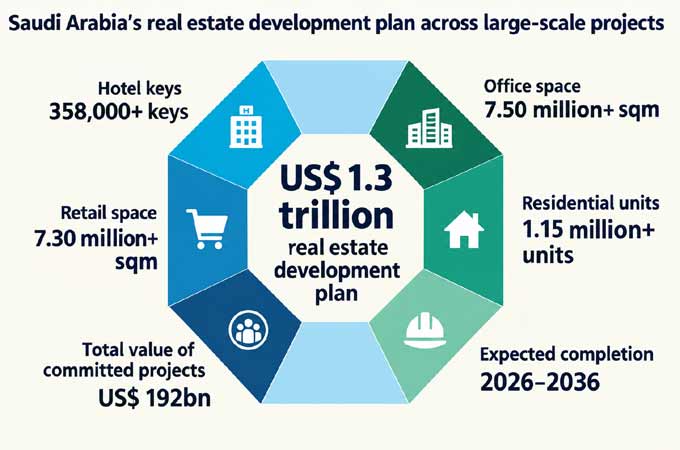
Saudi Arabia has approximately $1.3 trillion of planned real estate development within its large-scale projects pipeline.
Current plans include more than 1.15 million residential units, over 358,000 hotel keys, approximately 7.35 million sqm of retail space and more than 7.9 million sqm of office space, with delivery extending through to 2035.
The scale of the pipeline highlights the continued importance of construction and real estate to Saudi Arabia’s economic transformation. However, the timing and phasing of individual projects will remain subject to construction costs, procurement conditions, funding, project economics and the wider regional environment, the report said. -TradeArabia News Service