

























The Gulf Cooperation Council’s (GCC) forklift market is set to grow from $1.42 billion in 2025 to $1.95 billion by 2031, expanding at a compound annual growth rate of 5.43 per cent over the period, according to a report published by Mordor Intelligence.
The research firm said Saudi Arabia’s Vision 2030 projects are pulling equipment deliveries forward and shortening replacement windows. Lithium-ion batteries are now cheaper to own over their lifetime than lead-acid alternatives, a shift reinforced by incentive schemes including a 20 per cent capital-cost rebate in Saudi Arabia and the UAE’s Clean Energy Strategy 2050.
Growth in e-commerce fulfilment is also reshaping warehouse design in the region, Mordor Intelligence said, driving demand for narrow-aisle electric forklifts and order-pickers that improve storage efficiency in high-rent urban logistics hubs. The report described competitive intensity in the market as moderate, with global original equipment manufacturers (OEMs) defending premium market share through service contracts and rapid parts logistics.
High urban land costs and demand for same-day delivery services are driving vertical warehouse layouts. Facilities operated by major logistics players, including Amazon in Riyadh and Kezad in the UAE, are deploying high-density storage solutions, increasing the adoption of reach-trucks, order-pickers, and narrow-aisle electric units.
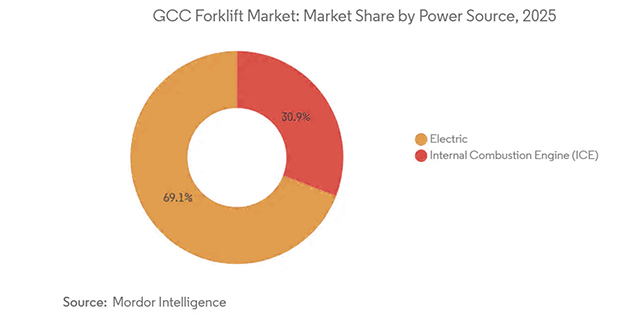
Electric forklifts accounted for 69.13 per cent of the GCC forklift market in 2025 and are forecast to grow at 7.34 per cent annually through 2031, underscoring the GCC forklift market shift toward lithium-ion economics. At Duqm Port in Oman, grid limitations led to the specification of diesel forklifts in 2025, underscoring the continued importance of internal-combustion units in outdoor settings. Battery-swap clauses, which transfer degradation costs to OEMs, help mitigate residual-value risks. Meanwhile, hydrogen fuel-cell trials at KAUST suggest a potential third pathway for the future, the report stated.
Fleet operators are balancing the penalties of desert heat against capital rebates, favouring suppliers with local battery-refurbishment programmes that complete the lifecycle loop. In the GCC forklift market, Chinese brands are gaining a competitive advantage by partnering with Dubai’s battery recycling plant Dubatt, effectively reducing midlife replacement costs, according to Modor.
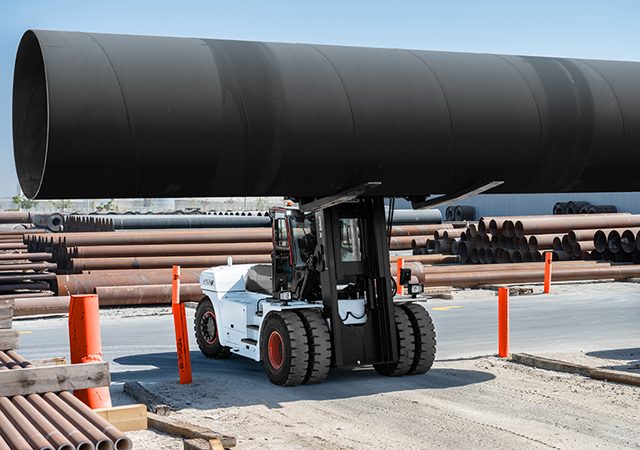
By forklift class, Class 4/5 units held 43.55 per cent of the market in 2025, while Class 1 electric rider trucks are expected to expand at 8.04 per cent annually between 2026 and 2031. The five- to 10-tonne capacity segment accounted for 60.03 per cent of the market in 2025, with the above-10-tonne category forecast to grow at 5.94 per cent annually.
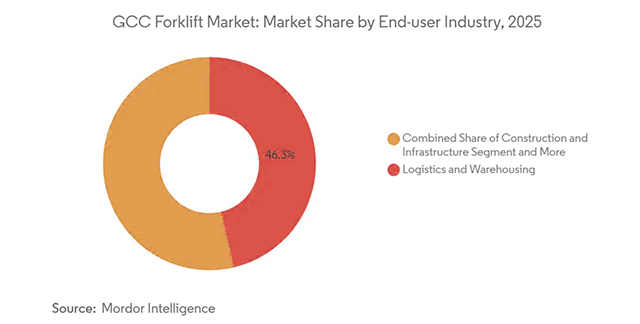
Logistics and warehousing represented 46.31 per cent of the market in 2025 and is projected to grow at 6.21 per cent annually through 2031, according to the report.
Counterbalanced forklifts held 68.15 per cent of the market by product type in 2025, while warehouse trucks are forecast to grow faster, at 7.61 per cent annually, over the 2026-2031 period.
Regional market
Saudi Arabia led the region with 38.06 per cent of the GCC forklift market in 2025 and is forecast to post the fastest growth of any GCC country, at 6.58 per cent annually through 2031, the report said. Mordor Intelligence attributed this to Vision 2030 megaprojects including NEOM Port, where Phase One construction includes automated ship-to-shore cranes supported by additional forklifts, and where the typical multi-year equipment replacement cycle has been compressed into a shorter purchasing window. The Red Sea Project and the Qiddiya entertainment city development are also securing multi-year equipment leases with local distributors, the report said.
The report said summer temperatures above 45 degrees C in Saudi Arabia reduce battery range by 23 per cent, prompting operators to invest in climate-controlled charging facilities and automated guidance systems that reduce dependence on driver skill.
The UAE ranked second in the region, the report said, citing the ramp-up of operations at Jebel Ali and long-term third-party logistics leases at the Kezad logistics park that insulate equipment orders from oil-price volatility. The UAE’s battery recycling infrastructure gives operators a cost advantage on closed-loop batteries relative to neighbouring countries, the report stated.
Qatar, Kuwait, Oman and Bahrain make up the remainder of the market, the report said. Qatar’s North Field LNG project and the expansion of Hamad Port are driving forklift demand, while Kuwait is delaying tenders due to budget constraints. Bahrain’s new logistics park in Hidd is transitioning to electric fleets in line with regional sustainability mandates, according to the report. Saudi Arabia’s SASO technical regulation, introduced in 2026, streamlines safety standards for forklifts and adds a compliance cost per unit, which the report said eases cross-border transactions within the GCC forklift market.
Demand drivers
On demand drivers, Mordor Intelligence identified mega infrastructure projects as the largest contributor to market growth, adding an estimated 1.8 percentage points to the compound annual growth rate, followed by the e-commerce-led warehouse boom at 1.5 percentage points and the shift to electric and lithium-ion forklifts at 1.3 percentage points. On the restraint side, the report identified oil-price volatility as the largest drag on growth, subtracting an estimated 0.8 percentage points, followed by a shortage of certified forklift operators at 0.6 percentage points.
On the operator shortage, Mordor Intelligence said job postings in 2025 increasingly required certified candidates, pushing up wage expectations across the industry, while fragmented cross-border licensing requirements have contributed to workforce turnover. Some companies have responded by adopting semi-automated driver assistance technology and offering bundled training contracts, according to the report.