

























Saudi Arabia’s national railway operator has issued a tender for design consultancy services on the kingdom’s 672-km section of the Gulf Cooperation Council’s (GCC) long-delayed railway, a development that signals fresh momentum behind one of the region’s most ambitious infrastructure undertakings.
Saudi Arabia Railways (SAR) floated the tender on May 7, with bids due by June 30. The consultancy contract covers concept design, preliminary design and Issued for Construction (IFC) design stages for the Saudi segment, which will run from Al-Khafji in the Eastern Province – near the Kuwaiti border – southward to Al-Batha at Saudi Arabia’s frontier with the UAE. The move comes less than a year after Kuwait inked its own design contract with a Turkish firm for its portion of the network, giving the project its most coordinated bilateral push in years.
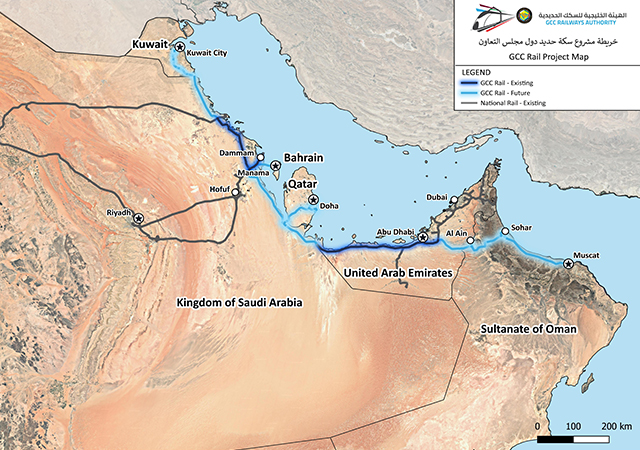
When complete, the GCC Railway will stretch 2,117 km from Kuwait City in the north to Muscat in the south, linking six nations – Kuwait, Saudi Arabia, Bahrain, Qatar, the UAE and Oman – in what planners describe as the world’s most ambitious cross-border rail integration project outside Europe.
The network is projected to serve six million passengers annually by 2030 and carry 201 million tonnes of freight, with passenger trains designed to travel at 220 km per hour and freight trains at 80 to 120 km per hour.
Tracing its history
Plans for the GCC Railway can be traced back to the GCC Summit in 2003, when feasibility studies were first commissioned.
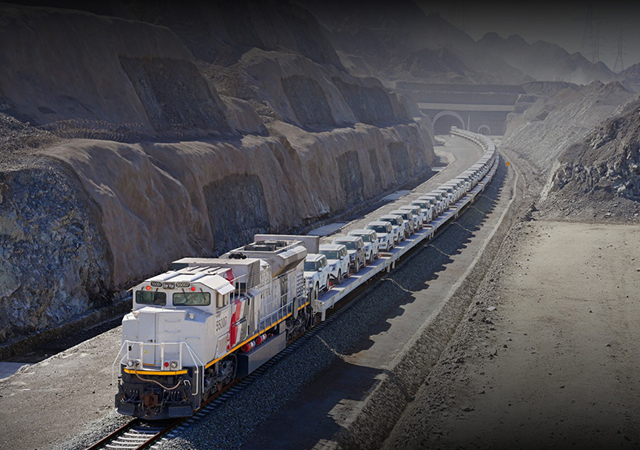
Etihad Rail has achieved the most advanced domestic network, having connected the Saudi border to Fujairah through all seven emirates.
The Gulf Railway project was flagged off at the 30th GCC Summit in Kuwait City in December 2009, with an original deadline to complete the project of 2018, later postponed to 2021. Fiscal pressures associated with the oil price drop of 2014 and, more recently, the Covid-19 pandemic and diplomatic tensions in the regin caused further delays.
Following the Al-Ula Declaration signed on January 2021, at the 41st Gulf Cooperation Council (GCC) Summit in Saudi Arabia which restored GCC diplomatic ties, the six member states began revisiting the railway with renewed seriousness. In December 2021, GCC leaders approved the establishment of a GCC Railways Authority to coordinate the project. By December 2023, transport ministers had set binding administrative, legal and financial rules governing that authority, approved its budget and ratified a general agreement outlining each member state’s obligations – with a December 2030 target date, when operations and connectivity would start between any two neighbouring countries where the project has been completed.
The GCC national network
Kuwait, which will serve as the railway’s northern terminus, announced its intention to build a roughly 160-km national network in 2009, but the project was suspended in 2015 and remained stalled for years.
That changed in April 2025 when Kuwait’s Public Works Minister Noura Al-Mashaan signed an $8-million design contract with Turkish consultancy Proyapi Muhendislik ve Musavirlik Anonim Sirketi for the first phase of the Kuwait National Rail Road (KNRR). The Saudi tender issued last month is explicitly designed to interface with the KNRR at the Kuwaiti border.
Late last month, Kuwait’s Municipal Council approved a route corridor for the Kuwaiti section of the planned high-speed railway. Running approximately 85 km from the country’s southwestern border with Saudi Arabia to the Shadadiya area near Kuwait’s new university campus, this section forms part of a broader 500-km Saudi-Kuwait corridor designed to connect the two capitals through high-speed passenger services. At the request of the Ministry of Public Works, the council designated the right-of-way required for the railway within Kuwait. Trains travelling at speeds of up to 300 km/h are expected to cover the journey between Riyadh and Kuwait in less than two hours, with three daily round trips planned.
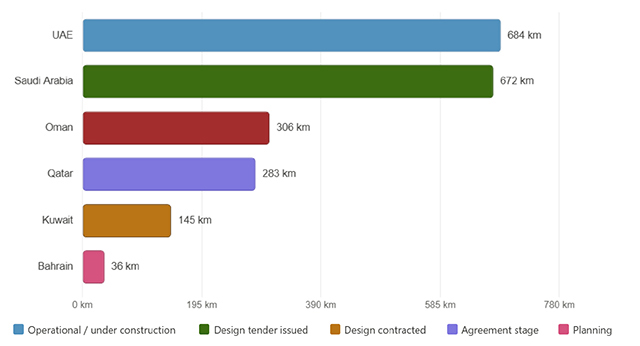
The current status of the GCC railway network.
The Saudi section of the GCC Railway network, spanning 672 km, is the longest continuous national segment and structurally the most critical: without it, northern and southern portions of the network remain disconnected. Construction of the Saudi-Kuwait link is scheduled to begin this year, with a target completion of 2028, according to plans disclosed in 2024.
While the northern sections remain in design phases, the UAE-Oman segment – branded Hafeet Rail – has emerged as the project’s most concrete proof of concept. A joint venture between Etihad Rail, Oman Rail and Mubadala Investment Company, it is billed as the first modern cross-border railway in the Arab world. Named after Jebel Hafeet, the mountain straddling the UAE-Oman border, the 238-km primary corridor will run from Sohar Port in northern Oman through Al Ain to Abu Dhabi, connecting 12 passenger stations, five major seaports and more than 15 integrated freight facilities.
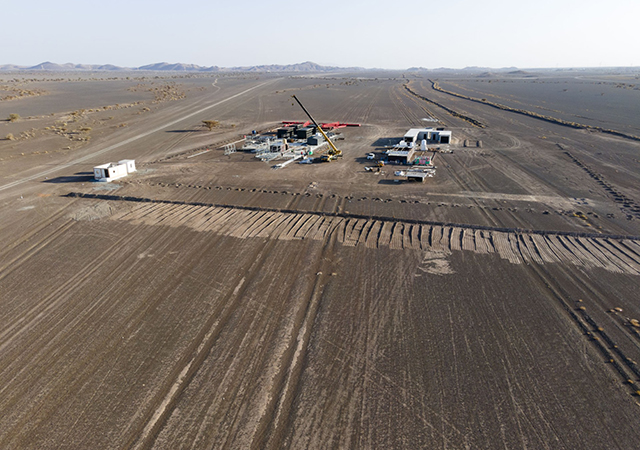
The project was first announced in 2022 and rebranded as Hafeet Rail in April 2024, when civil works contracts worth AED5.5 billion ($1.5 billion) were signed and ground was formally broken. Construction has since advanced across Al Ain, Al Buraimi, Sohar and Wadi Al Jizzi, with crews cutting through desert and mountainous terrain that requires tunnels, viaducts, bridges and flood protection systems. As of late April, Hafeet Rail announced the project had reached 40 percent completion (see separate article). Despite this progress, Oman has yet to break ground on its broader 2,135-km national network.
The UAE has achieved the most advanced domestic network of any GCC member. Etihad Rail has already connected the Saudi border to Fujairah through all seven emirates – a fully operational freight system that now forms the UAE backbone for the wider GCC project.
Work is now under way on the passenger network. The UAE’s first fully integrated national passenger rail network is designed to connect 11 cities and regions through an advanced transport system which will travel at 200 kmph. It will include stations in Abu Dhabi, Dubai, Sharjah, Fujairah, Sila, Al Dhannah, Mirfa, Madinat Zayed, Mezaira’a, Al Faya, and Al Dhaid, with services introduced in phases in line with future growth and expansion requirements.
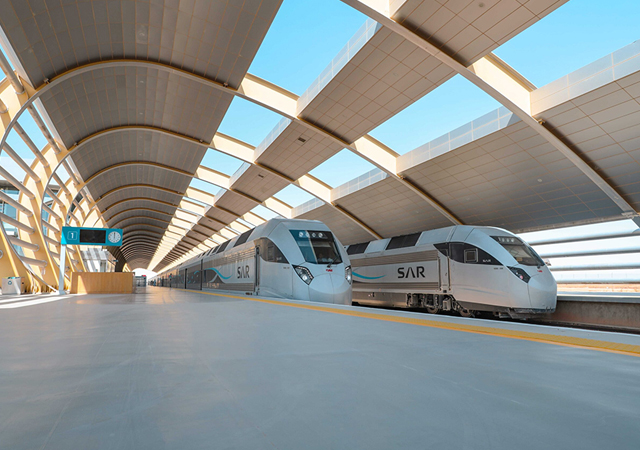
Saudi Arabia operates an extensive domestic rail network, including the Haramain High-Speed Railway and the SAR freight lines.
In February, Etihad Rail awarded design-and-build contracts worth an estimated $6.5 billion for the civil works and station packages of a new high-speed railway (HSR) line connecting Abu Dhabi and Dubai. The contract for the construction of the Abu Dhabi side of the railway was awarded to a consortium comprising Abu Dhabi’s National Projects Construction (NPC), Trojan Tunnelling, Turkiye’s Kalyon and China State Construction Engineering Corporation; while the deal for the Dubai side of the railway went to a consortium of India’s Larsen & Toubro, China Harbour Engineering Company and local firm Wade Adams.
The new high-speed train, running at 350 kmph will reduce the travel time between Dubai and Abu Dhabi, to just 30 minutes. This is in addition to the regular rail passenger train services that will be rolled out this year.
Saudi Arabia already operates an extensive domestic rail, including the Haramain High-Speed Railway linking Makkah and Madinah, the Dammam-Riyadh link and the SAR freight network. New additions include the Q-Express Line – formally the Qiddiya High-Speed Rail Project – which will connect King Salman International Airport, the King Abdullah Financial District (KAFD) and Qiddiya City in 30 minutes under a public-private partnership model.
The long-awaited $7-billion Saudi Landbridge project is also moving ahead: Spain’s Typsa has secured a design contract following a 2025 tender, covering a freight-led network of more than 1,500 km that will strengthen east-west connectivity by linking Jeddah with Riyadh and onward to the North-South Railway and Dammam, with completion planned in phases by 2034.
The kingdom is also set to develop a new high-speed link with Qatar. In October 2025, the Qatari cabinet approved a framework agreement for a rail connection with Saudi Arabia; Saudi Arabia’s cabinet followed in February 2026 with formal approval of a landmark bilateral agreement. The resulting 785-km electric high-speed railway will link Riyadh and Doha at speeds exceeding 300 km/h, with major intermediate stops at Al-Hofuf and Dammam in Saudi Arabia and terminals at King Salman International Airport in Riyadh and Hamad International Airport in Doha.
Construction is expected to take approximately six years, targeting completion in the early 2030s.
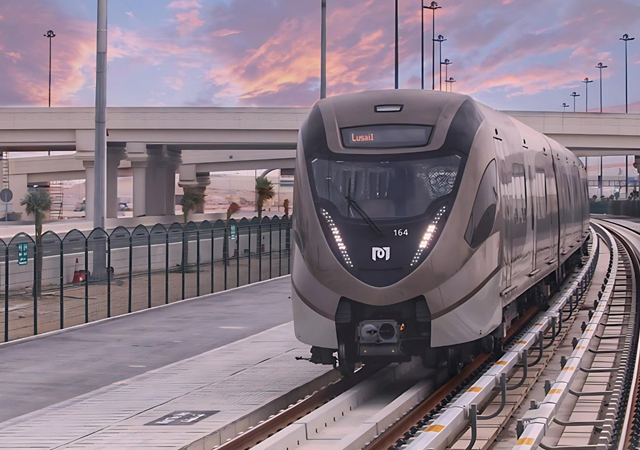
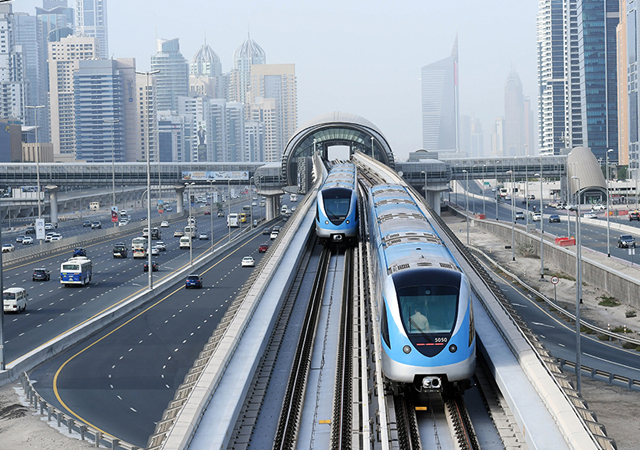
Qatar has built a modern metro and rail network that meets GCC technical standards, though it was not originally designed to connect to the broader cross-border system.
Qatar has built a modern metro and rail network that meets GCC technical standards, though it was not originally designed to connect to the broader cross-border system. The Saudi-Qatar agreement marks a significant step toward closing that gap.
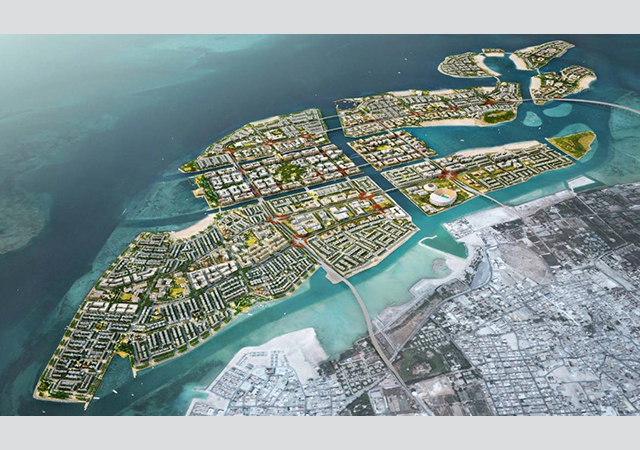
Bahrain, with just 36 km allocated in the overall plan, has no national railway and has only begun planning for a light rail system. The separate GCC railway section would cross into Saudi Arabia via a proposed new King Hamad Causeway project. Running parallel to the King Fahd Causeway, the new 57-km causeway will include four road lanes and two rail tracks, linking the proposed King Hamad International Station in the Ramli area in Bahrain to Dammam Railway Station in Saudi Arabia.
Dammam Railway Station will serve as the hub connecting Bahrain’s rail network with all railways in Saudi Arabia. The passenger terminal at King Hamad International Railway Station in Ramli will link to Bahrain International Airport and to other commercial and residential areas through the proposed Bahrain Metro.
The GCC Railway network’s allocated route lengths include: 684 km in the UAE, 672 km in Saudi Arabia, 306 km in Oman, 283 km in Qatar, 145 km in Kuwait and 36 km in Bahrain.
The total project cost has been revised downward by GCC economy ministers to approximately $15 billion under the current scaled framework.
Strategic value
The GCC Railway project is entering its most promising chapter yet. With Saudi Arabia formally entering the design market, Kuwait securing active contracts, Hafeet Rail rapidly approaching its halfway milestone, and Qatar advancing vital bilateral agreements, the vision for a unified regional network is moving closer to reality than at any point in its 17-year history.
This historic progress highlights a powerful opportunity for synchronised regional growth. Because the network is designed to function as an interconnected whole, each national segment is moving forward in parallel. This collaborative pacing ensures that all member states advance together, creating a unified timeline where early milestones in one nation directly support and elevate the efforts of neighbours.
Beyond the logistical benefits, the GCC Railway carries significant geopolitical and economic symbolism. Analysts at the Observer Research Foundation and elsewhere have noted that the project could serve as the backbone of a future GCC customs union, potentially raising intra-regional trade well above its current nine per cent of total exports.
The railway also aligns with the India-Middle East-Europe Economic Corridor (IMEC), the multimodal trade route unveiled in 2023 that runs from India through Gulf ports to Europe. A fully integrated GCC rail network would strengthen the Gulf’s role as a central node in Eurasian logistics, reducing dependence on maritime chokepoints like the Strait of Hormuz.
For Saudi Arabia, whose Vision 2030 programme aims to attract 100 million tourists annually and raise tourism’s share of GDP beyond 10 per cent, faster cross-border rail links offer a direct instrument of economic diversification. For Oman and the UAE, Hafeet Rail is already being marketed as a corridor for leisure travel, with the journey through desert and Hajar Mountain scenery positioned as an attraction in its own right.
Environmental arguments add a further dimension. Etihad Rail has stated that its network can reduce road emissions by 21 per cent annually by 2050, with each freight train capable of taking up to 300 trucks off Gulf highways.
While a cross-border project of this scale naturally requires navigating complex technical landscapes and budget cycles, the current alignment among GCC nations demonstrates a renewed, resilient political will. The region is actively transforming its long-held transport aspirations into laying real tracks, positioning the GCC Railway as a landmark achievement in regional connectivity, economic integration, and shared success.