


















































Commercial workspaces across the UAE are changing faster than design standards are keeping up. Office footprints are becoming more compressed, utilisation rates are climbing, and available spaces must serve multiple functions in a single day.
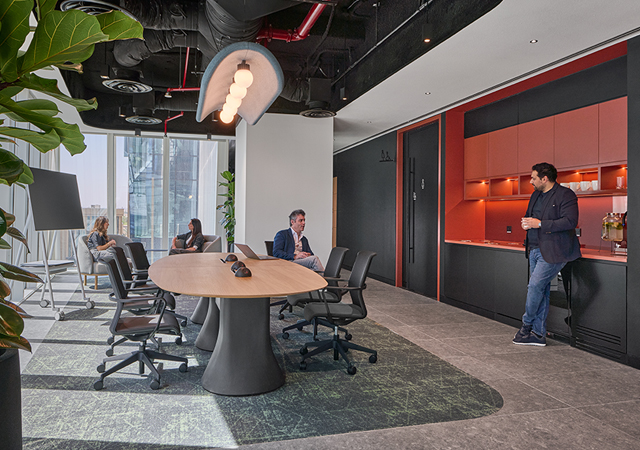
For instance, meeting rooms must double as video conferencing hubs, open collaboration spaces are transformed into presentation venues, and focus areas often sit next to high-energy team spaces.
Given these dynamics, the importance of acoustic performance in the design considerations of commercial workspaces cannot be ignored.
CBRE reports that average office occupancy in the UAE reached 94 per cent at the end of 2024, with leasing rates rising roughly 20 per cent year-on-year. High utilisation and premium rental costs mean every square metre must perform efficiently. When acoustic conditions fail to meet the requirements of the commercial users, they not only experience discomfort but also have limited flexibility in how the spaces are used. Furthermore, retrofitting acoustic solutions is expensive, leaving many property owners and lessees unhappy.

Khazi: “Acoustic intent must be established at the concept stage.”
At the same time, hybrid work patterns are reshaping how offices are used. A GulfTalent survey covering professionals across the GCC found that 18 per cent now operate in some form of remote or hybrid model, with the UAE leading at 21 per cent. Offices have, therefore, evolved from rows of fixed desks and cubicles to collaboration and culture spaces. This creates even greater demand for commercial spaces that support speech clarity in group settings, offer privacy for focused work, and provide comfort in shared environments.
Design considerations
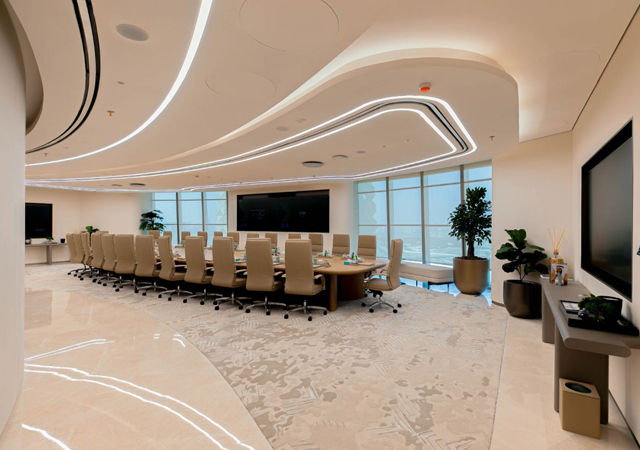
Designers and project consultants are now tasked with a more complex acoustic brief. Multi-function commercial spaces require control of reverberation, management of background noise, and protection of speech privacy, all while preserving visual openness and architectural intent. This is where accurate specification briefings are essential. Acoustic solutions must be selected based on performance data, integration with building systems, and compatibility with local climate conditions, rather than treated as decorative afterthoughts.
For instance, ceiling-based absorption systems have become essential in open-plan and shared collaboration zones, where uncontrolled reflections quickly degrade speech intelligibility. Transparent partition systems respond to the parallel demand for daylight access and visual connectivity, while still requiring embedded acoustic performance to maintain privacy. Wall and fabric-based absorptive elements offer further tuning of a room’s acoustic response, especially in mixed-use environments where layouts may evolve. The effectiveness of these solutions depends on early coordination with lighting, HVAC, and mechanical systems.
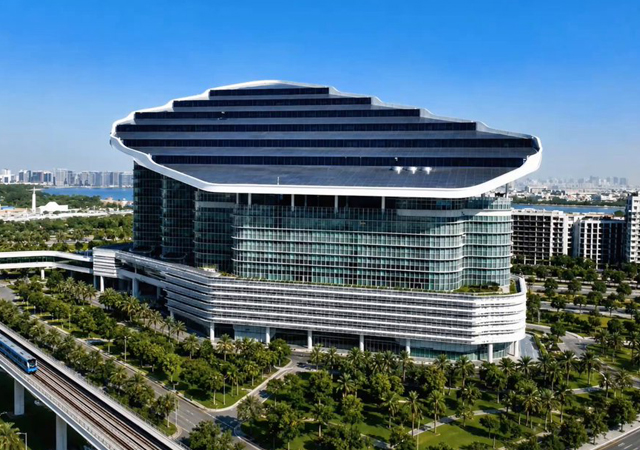
Al Shera’a building in Dubai showcases a commitment to acoustic comfort and high-performance interior environments.
Regional conditions add further layers to specification decisions. Materials must remain dimensionally stable under high heat and humidity. Interior finishes must comply with the fire and life safety requirements outlined in the building codes.
Acoustic performance, therefore, intersects with regulatory compliance. Documentation frameworks, such as Dubai’s Green Building Code, explicitly incorporate acoustic comfort considerations into project approval processes. This reinforces the fact that acoustic planning sits within broader risk management and building performance responsibilities.
A collective effort
The practical implication for architects, interior designers, and project managers shows that acoustic intent must be established at the concept stage. Waiting until fit-out or post-occupancy almost always leads to compromised outcomes.
Retrofitting absorptive systems after occupancy disrupts operations, increases budgets, and rarely delivers the same performance as integrated design. Early collaboration between acoustic specialists, design teams, and project consultants ensures that functional requirements, compliance obligations, and aesthetic goals align from the beginning.
As commercial environments across the UAE continue to evolve toward higher density, greater flexibility, and more varied activity patterns, commercial spaces must become more proactive around acoustic requirements. In this regard, intelligent specification is not about adding more material but about placing the right solutions in the right locations at the right stage of the design process.
* Amna Khazi is Senior Executive Manager at Europhon Acoustics, a specialised division of Euro Systems focused on high-performance and sustainable acoustic solutions for commercial and residential interiors.