











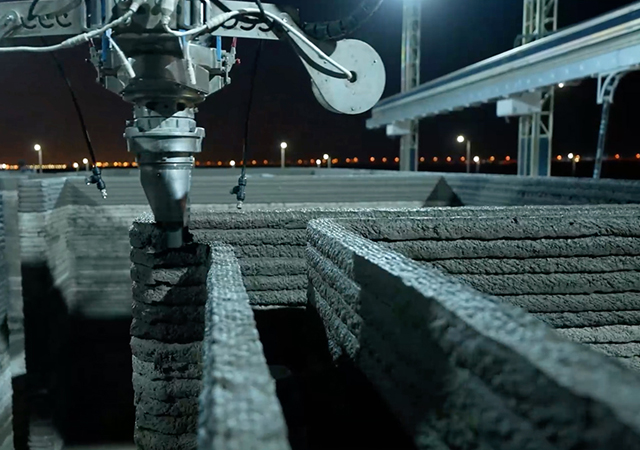
As governments and developers across the Gulf seek faster, more sustainable and technologically advanced methods of construction, 3D concrete printing (3DCP) is steadily progressing from experimentation to mainstream application. Among the companies driving this shift is Denmark-based COBOD International, whose printer systems have been used on some of the region’s most ambitious additive construction projects, from villas and mosques to schools, hydrogen research facilities and water infrastructure.
According to Henrik Lund-Nielsen, Founder and General Manager of COBOD, the company’s engagement with the Gulf spans more than seven years and reflects the rapid maturation of the technology.
In an exclusive interview with Gulf Construction’s Bina Goveas, Lund-Nielsen says: “We have been active in the Gulf for more than seven years and we have sold around 10 printers to the region. Our printers have printed and are currently printing projects, which total around 30,000 sq m, which make up 40 small projects. Our printers have been utilised for everything from one-, two- and three-storey villas, overhead water tanks and a mosque to a school with several thousand square metres.”
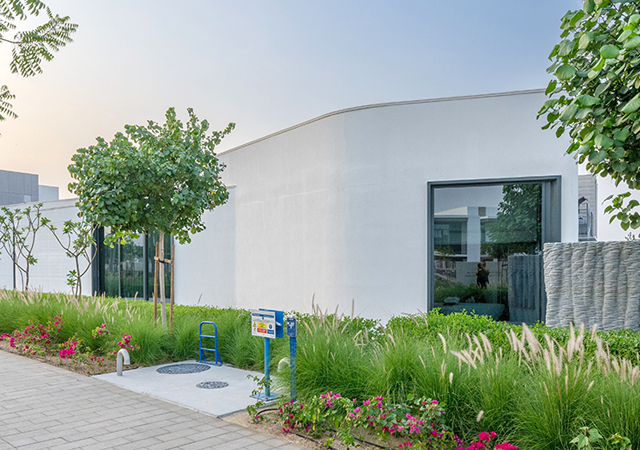
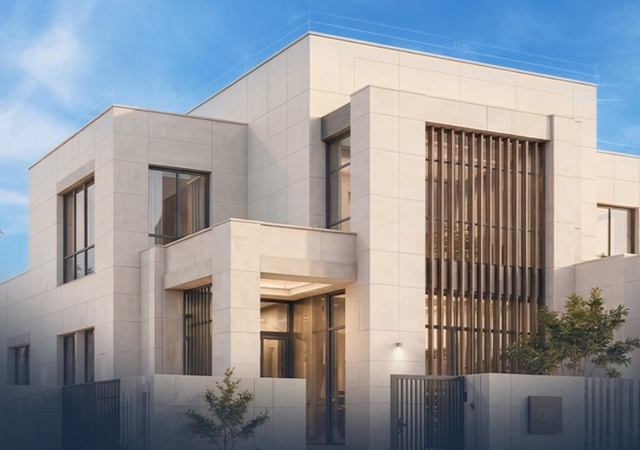
A 200-sq-m one-storey 3D concrete printed villa at Arabian Ranches III.
From a Dubai villa to regional scale
COBOD’s Gulf journey began in Dubai with a pioneering residential project for leading UAE real estate development company Emaar.
Lund-Nielsen elaborates: “It began with a 200-sq-m one-storey villa made for Emaar at the Arabian Ranches III in Dubai printed way back in 2019. The project was not officially unveiled until 2022, however, as the Covid-19 pandemic led to several delays in its launch. At the time, both the technology and our team were still relatively inexperienced, and the printing process took several weeks to complete. Today, the same villa could be printed in less than a week.”
The project represented an important milestone for the region’s emerging additive construction sector. More significantly, it provided practical lessons that have since enabled much larger and more efficient projects.
Since then, the scale of developments undertaken using COBOD technology has expanded dramatically.
“We are increasingly seeing our customers move beyond one- or two-unit housing projects of a few hundred square metres to developments comprising 10, 15 or even more units, with several thousand square metres being printed. This is an encouraging trend, as projects of this scale are where 3D construction printing becomes truly profitable, enabling contractors to improve competitiveness and gain market share. We are pleased to see more and more of our customers reaching this stage,” he adds.
The shift from standalone demonstration buildings to multi-unit developments is widely regarded as a critical step towards achieving commercial viability in 3D construction printing.
Lund-Nielsen also points out that the company’s printers always print with real concrete not drymix mortars, as these are seven to 10 times more expensive than concrete.
“We really stand out with our ability to print with concrete. Virtually all other projects in the region are made with mortars,” he emphasises.
Saudi Arabia pushes the boundaries
Saudi Arabia has emerged as one of the most active markets for the technology, supported by the kingdom’s broader drive to industrialise construction and accelerate housing delivery under Vision 2030.
 BIG.jpg)
A 3D-printed villa constructed by Dar Al Arkan.
COBOD supplied two printers to Saudi developer Dar Al Arkan, which were used to deliver a globally significant project in Riyadh.
“We have sold two printers to Dar Al Arkan who in 2023 used them to build two three-storey villas in Riyadh, which at the time, were the tallest 3D printed buildings in the world with a height of 9.9 m.”
The achievement attracted international attention and demonstrated the structural capabilities of modern concrete printing systems.
Since then, Dar Al Arkan has expanded its portfolio, executing multiple greenfield and brownfield projects for energy giant Aramco. While many Aramco projects remain confidential, Lund-Nielsen confirms that the developer printed a mosque for the company in 2024. Furthermore, Dar Al Arkan and COBOD have delivered multiple structures for NEOM, including various types of accommodation units and guest houses.
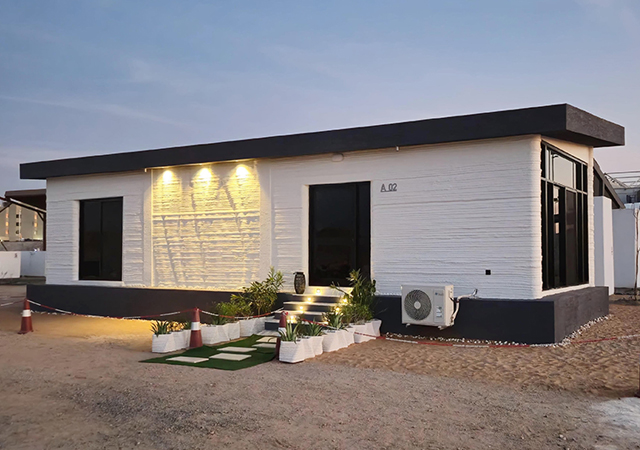
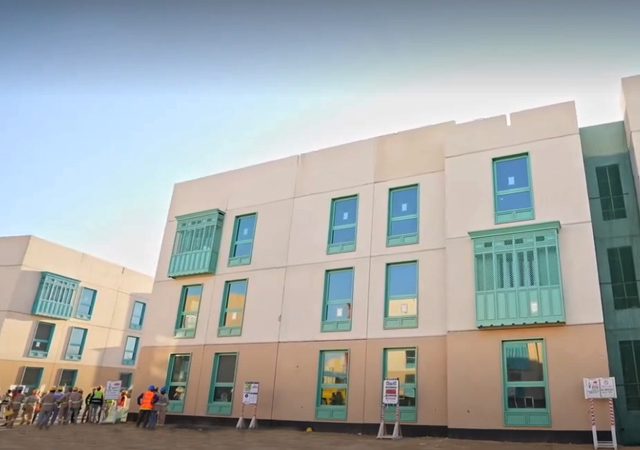
Multiple structures have been constructed using 3D printing technology for NEOM.
The momentum in Saudi Arabia is poised to accelerate. Another COBOD customer is gearing up to launch a residential development in the kingdom featuring 15 housing units – a project size that perfectly hits the sweet spot for maximum 3DCP cost-efficiency, Lund-Nielsen says.
Simultaneously, Dar Al Arkan is crossing borders into the UAE, where it will soon break ground on a new project featuring a collection of large, 3D-printed villas.
Innovation in Oman and Kuwait
Beyond massive housing developments, COBOD’s partners in Oman and Kuwait are demonstrating how 3DCP can revolutionise architectural geometry and resource conservation.
.jpg)
The 322-sq-m Hydrogen Center building in Muscat ... newly unveiled.
In Oman, the German University of Technology (GU Tech) has emerged as a beacon of architectural innovation. In 2024, GU Tech printed an organically shaped café that fully capitalised on the radical design freedom inherent to 3D printing, creating fluid, curved walls that would be prohibitively expensive or complex using traditional formwork.
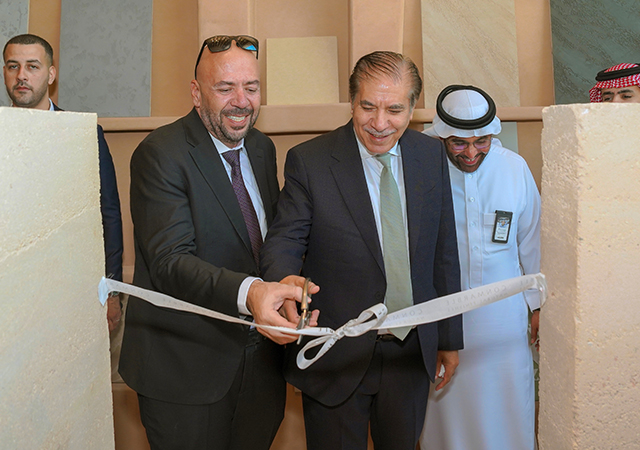
Last month, GU Tech unveiled the H2 Lab, a stunning 322-sq-m Hydrogen Center building – known as H2 Lab – in Muscat. Serving as a high-tech showroom to demonstrate cutting-edge hydrogen technology, the facility was officially launched at a grand opening reception attended by several government ministers.
GU Tech’s operational model is unique: it frequently utilises an on-site prefabrication method. Because 3D printing eliminates the need for temporary formwork, these concrete elements can be manufactured incredibly fast. By setting up the printer directly adjacent to the final installation site, transport costs and logistical headaches are virtually eliminated, he says.
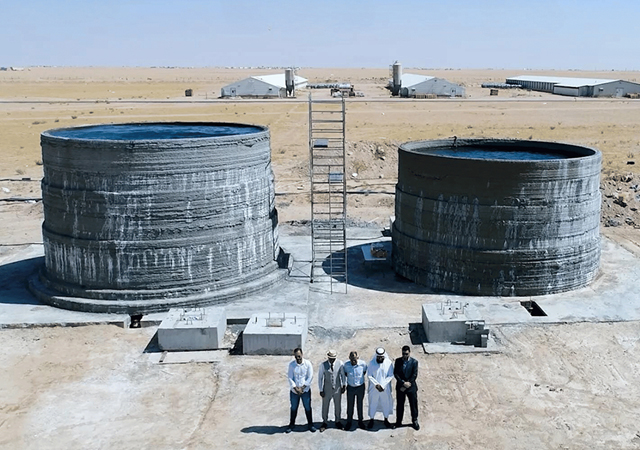
The world’s first 3D printed water tanks were built by Abyan in Kuwait in 2024.
In 2024, Abyan made history in Kuwait by printing the first 3D-printed water tanks in the world. Standing 4.5 m tall with a diameter of 7 m, these structures represent a massive leap forward for environmental engineering.
By leveraging the precise control of the 3D printer, Abyan reduced total material consumption by 25 per cent compared to conventional construction methods. The printer achieved this by gradually decreasing the thickness of the concrete walls as they approached the top, matching the reduction in hydrostatic pressure. This variable wall thickness is economically impossible to replicate with traditional casting. This slashes material costs, construction time, and the overall carbon footprint, according to Lund-Nielsen
Breaking World Records in Qatar
When asked which GCC development brings the most pride to COBOD, Lund-Nielsen points without hesitation to an ongoing, historic mega-project in Qatar.
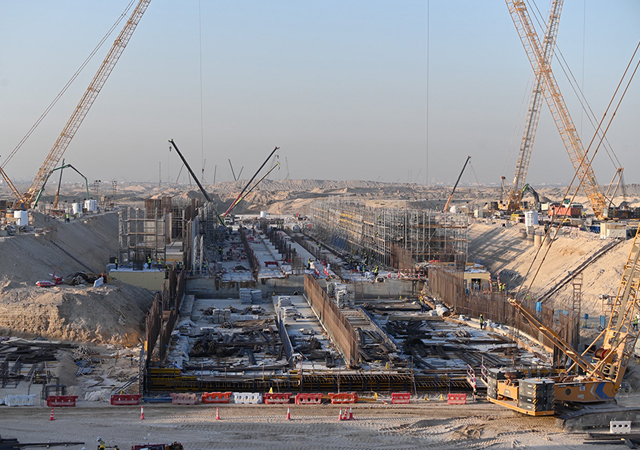
In Doha, UrbaCon Trading & Contracting (UCC) is currently 3D printing a school building that shatters all previous industry benchmarks. Spanning an immense footprint of more than 10,000 sq m, the project is on the verge of completion.
The building features a footprint measuring 100 m in width by 100 m in length. This project stands as a world record. No larger 3D-printed project exists anywhere on Earth, he states, adding: “This project beats the previous record more than 10 times and moves our industry forward by many years. I am sure when the project is revealed to the public the whole construction (industry) will open its eyes to what is really possible with 3D printing. This project surpasses anything that has been done before and surpasses our wildest imagination.”
To make a project of this magnitude possible, COBOD supplied UCC with two units of its BOD XL system, the largest construction printer type in existence.
Each of these massive printers measures 50 m in length, 30 m in width, and 15 m in height. While the final architectural reveal belongs strictly to UCC, the sheer presence of these twin mechanical giants on-site signals a turning point. 3D construction printing is no longer a niche alternative; it has officially graduated to the macro-scale, he concludes.